
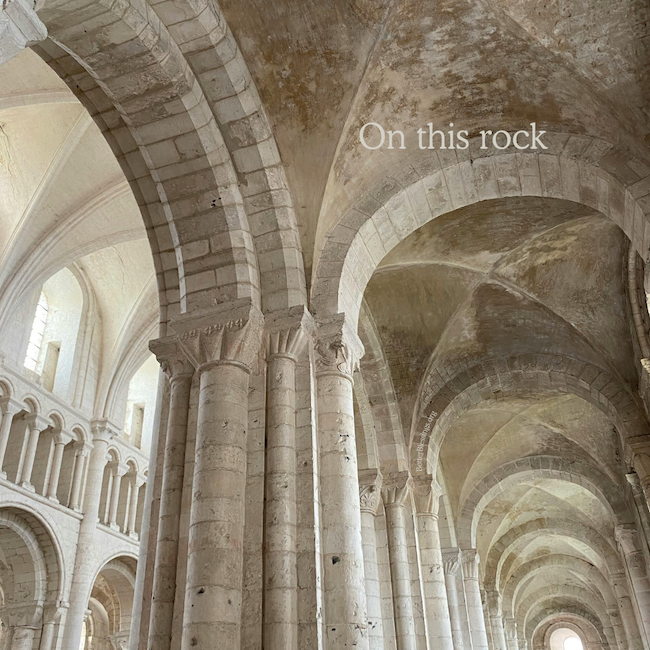
Rocky Church
Can we all agree that no church does it exactly right? By “it” I mean the weekly service, worship, preaching, community outreach, and so on. By “exactly right,” I mean perfectly as God intends it to be done. And by “church” I mean… Well, that is what this article is about, so let’s jump into it.
When it comes to churches, it seems that many believers have Goldilocks Syndrome. Some churches are too hot, and others are too cold. However, unlike the fairytale, many congregants cannot find that “just right” church. This results in continual “church hopping.” The Christian is never grounded in a community of believers and is therefore vulnerable to attack by the enemy.
What if church attendees, church-hopping around towns throughout the U.S., are looking at the wrong factors in their search? What if people’s considerations are solely on the types of churches available, while the more essential factor is what church actually is? The book of Acts describes what many consider the formation of the “early church.” In the days when the book of Acts was written, people did not refer to their community as the church. They referred to the community of believers as “disciples,” “people of the way,” or “the believers.” They were Jesus' followers. People who hung onto the belief that the dead rabble rouser named Jesus was the Christ, the Son of God.
As the community grew in number and expanded throughout the known world, the Greek word “ekklesia” began to be used to label the believers. In Antioch, the label “Christians” was first used years after the original formation of the community of believers. Interestingly, Bible readers have chosen to translate ekklesia as “church.” However, in ancient Greece, the term was used to refer to any assembly, particularly the assembly of citizens into city-states. This, by the way, was the word Jesus used in referring to the ekklesia that He would build on the Rock.
What exactly is this ekklesia, and is it different from what we refer to as church today? In order to compare the two terms, let’s take another look at the book of Acts and those pesky early followers of Christ. What were the early believers doing? Praying a lot, being filled with the Holy Spirit, miraculous signs, studying the Word of God, being taught by the Apostles, worshiping God, united and sharing everything together as a community. The ekklesia made disciples - adding to their numbers.

Did Jesus intend for doctrine and dogma to be built on the rock?
As the community grew, two things happened: First, a guy named Saul was commissioned to destroy the community of believers, which led to intense persecution and the scattering of the believers. Second, a structured organization was instituted to effectively conduct the business of the ekklesia. The Christians could not continue to operate with everyone openly sharing everything haphazardly. There had to be some leadership to decide where the shared belongings would go and how they would be used. I suggest that this is where you begin to see the transformation of the ekklesia into what we call the church today.
The formation and spread of individual congregations furthered knowledge and belief in the Good News of Jesus Christ. However, it also increased human governance, leading to segregation around doctrine. The Lord gave instructions for the first part, the formation of the ekklesia, to happen, but He did not commission the second part, the doctrinal segregation. The Great Commission includes the following statement:
There is absolutely no reference to establishing separate denominations, building cathedrals, investing in elaborate sound systems, or teaching about “self-help” to make yourself richer and better. It could be argued that our Lord never intended for His ekklesia to have buildings at all. Did He ever build a building? No. Some might argue that His mission did not require a building. Simple response - Jesus’ mission was to save those lost in sin and to glorify His Father in Heaven. That sounds like what believers should be doing today. If our Lord could do it without a building, why can’t we?
Now, after I potentially crossed the line, let there be clarification. I understand the usefulness of a building for assembly, teaching, and praising God. I understand that people can use a physical establishment to unite. But what happens when that building is used to establish a kingdom not of God, but of our own making? What happens when the “church” becomes the focus, not the Lord Jesus Christ? People lose their way.
Jesus never intended for His believers to be hung up on what building they attend or even the doctrines they hold to. Our Lord did not commission believers to make disciples to build a social club, a counseling clinic, or an inspirational event. Jesus was not intent on building a structure on the Rock! He was not interested in building a denomination on the Rock. His sole purpose for calling for an ekklesia was… you!
Our Lord desires an assembly of human beings united in the purpose of glorifying God Almighty.
What’s the point? Don’t be in a church. Be the church.

